
Evermore Arcade
Evermore Games LLCArcade
3.3840.00 Reviews
- Version
- 2.7.4
- Installs
- 100.00K
- Age Rating
- Mature 17+
Screenshots

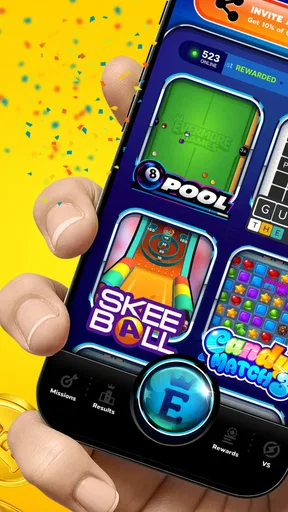

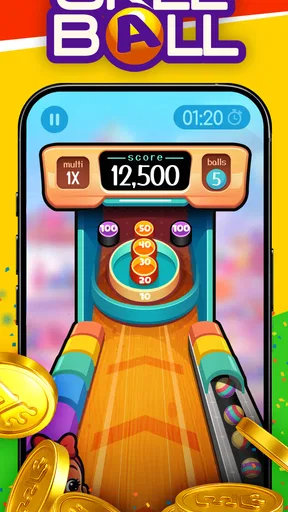
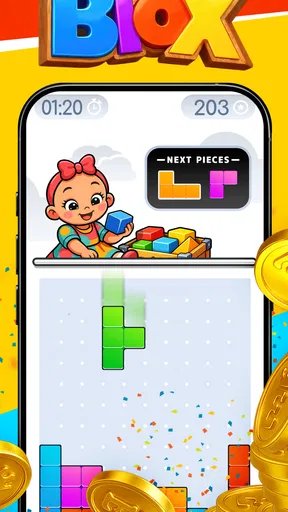

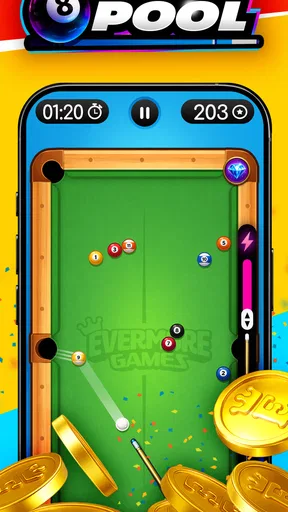
Our Review of Evermore Arcade
 Analysis by Appyee
I approached Evermore Arcade as a quick-play arcade game rather than as a traditional long-form title. Its central idea is simple: play skill-based games and work toward rewards. That sounds straightforward, but the important question for a new player is what “skill-based” feels like in practice and whether the reward angle improves the experience or distracts from it. After spending time with it, I see a game aimed at people who enjoy short challenges, repeated attempts, and the satisfaction of gradually improving a result.
The game is free to download and comes from Evermore Games LLC. It sits in the arcade category, carries a Mature 17+ content rating, and has attracted over one hundred thousand installs. Those details place it somewhere between a casual time-filler and a more focused competitive distraction. I would not describe it as a deep adventure or a replacement for a full console-style game. Its appeal is in opening it when I have a few spare minutes, concentrating on a challenge, and deciding whether another attempt is worth my time.
What the first session feels like
The first thing I would tell a friend is to keep expectations realistic. This is not the kind of game where I would expect a large world, a long story, or a complicated character-building system. The attraction is the action itself: making accurate decisions, reacting quickly, and learning from mistakes. That makes the experience easy to understand, but it also means the quality of each session depends heavily on whether I am in the mood to repeat a challenge and refine my performance.
The reward-focused presentation gives each attempt a little more importance than an ordinary arcade round. In a typical arcade game, failing may only cost a few minutes. Here, the possibility of earning something makes me pay closer attention to the rules and the result of each action. That can be motivating, especially when I feel that improvement comes from practice rather than luck. It can also create pressure, so I prefer treating the reward element as an extra goal instead of assuming that every session will produce a meaningful return.
That distinction matters for first-time players. I would begin by learning how the individual game works, not by chasing a reward immediately. The fastest way to become frustrated is to rush through the opening attempts without understanding what counts as a good performance. A few careful rounds give me a better sense of timing, control, and the point at which another attempt is actually useful.
The current release is version 2.2.1, and the game supports devices running Android 8.0 or later. For someone using an older phone or tablet, checking compatibility before planning a session is sensible. On a supported device, the practical question is less about whether the game is difficult to install and more about whether its short, skill-centered format fits the way that person likes to play.
Who is likely to enjoy it
I think the best match is a player who likes compact arcade challenges and does not mind repeating an activity to improve. If you enjoy trying to beat your own previous performance, spotting small mistakes, and staying focused for a few minutes at a time, the structure makes sense. It also suits people who prefer direct interaction over long tutorials or extensive menus.
It is less suitable for someone looking for a relaxing game with almost no pressure. The skill requirement means that concentration matters, and the reward concept may make a poor attempt feel more disappointing than it would in a purely recreational title. I would also skip it if my main goal were a rich narrative, social role-playing, or a large collection of unlockable content. The arcade format is the point, not a limitation that disappears later.
The Mature 17+ rating is another reason I would not recommend installing it casually for a younger player. Parents should pay attention to that age classification before handing over a device. For adults, it is still worth approaching the game as a focused arcade experience rather than assuming the rating tells me anything about the depth or difficulty of the gameplay.
Getting started without wasting the first attempts
My preferred first setup is deliberately cautious. I would install the game, open it when I have a few uninterrupted minutes, and read each instruction instead of tapping through automatically. In a skill-based title, the opening explanation is not disposable text. It may define the timing, scoring logic, or action that determines whether an attempt is worthwhile. Even a simple control scheme can feel unclear if I start pressing buttons before I know what the game is asking me to do.
I would also begin with a stable connection and a charged device, particularly because the game is built around rewards. That is not a claim about a particular technical requirement; it is simply a practical habit. Losing focus or closing the app halfway through an important attempt makes it harder to judge the game fairly. A quiet setting is more useful than a long session, because the early goal is to understand the rhythm rather than to play for hours.
One useful habit is to separate learning attempts from serious attempts. During the first round, I would deliberately test the controls and observe what happens after a mistake. During the next round, I would focus on repeating one improvement instead of trying to perfect everything at once. This approach prevents the common mistake of treating every early failure as evidence that the game is unfair. Arcade controls often feel more natural after I identify the exact moment when I am acting too early or too late.
I would keep the first session short enough to notice fatigue. Repeated skill games can become less accurate when I am tired, and that can make a challenge seem harder than it really is. If I miss the same action several times, I would pause, change my grip, and try again later rather than immediately assuming that another attempt will solve the problem. The reward angle makes it tempting to continue, but better concentration is usually more valuable than extra repetition.
How to recognize a meaningful first success
For me, a meaningful first success is not simply completing the opening interaction. It is reaching a point where I understand why the attempt worked. If I succeed because I used the correct timing or made a deliberate choice, I have learned something that can be repeated. If I succeed by accident while still confused about the controls, I would treat it as encouraging but not yet reliable.
A practical first-session target is to identify one action that consistently improves the result. That could mean waiting for a clearer moment, using a more controlled movement, or avoiding a rushed decision. I am not inventing a specific mechanic here; the useful principle is to look for the behavior that changes the outcome and practice that behavior on its own. Arcade games become much less mysterious once I stop trying to improve every part of a round simultaneously.
This is also where the game’s reward promise needs a sensible interpretation. I would not measure the first successful action by what I might receive. I would measure it by whether I can explain the success and reproduce it. That keeps the first session useful even if the reward-related outcome is smaller than expected. The game is still asking for skill, and skill develops through repeatable decisions, not hopeful tapping.
For an everyday example, I could see myself playing during a short break after finishing a task. I would use the first attempt to refresh my memory, the second to correct one mistake, and the third only if I still felt focused. If the game demands more attention than the break allows, I would stop rather than turn a quick diversion into an irritating chore. That is a better routine than opening it repeatedly whenever I feel impatient, because impatience is exactly when arcade accuracy tends to fall.
Where new players may become confused
The phrase “earn rewards” can create expectations that the game is primarily a rewards app with a small game attached. I would approach it in the opposite order: it is an arcade game first, and the reward possibility is part of the motivation. That mindset helps me judge the controls and challenge on their own terms. If I dislike the actual play, the reward idea alone is unlikely to make the experience satisfying for long.
Another possible source of confusion is the difference between progress and immediate success. A player may improve timing or decision-making without seeing a dramatic change after every attempt. I would watch for smaller signs: fewer rushed actions, a better understanding of the objective, and more consistent results. Those changes are easy to overlook when I focus only on the final outcome, but they are the foundation of a skill-based arcade loop.
I would also avoid assuming that one good round means I have mastered the game. Short arcade challenges can feel simple at first and then expose weaknesses when I try to repeat a result. The more useful test is consistency. Can I achieve a similar outcome after a brief pause? Can I describe what I did differently? If not, I would continue learning instead of treating one successful attempt as a guarantee.
There is a practical emotional trap here as well. When a reward is part of the motivation, a near miss can encourage one more attempt, then another, even when my concentration is gone. I recommend setting a personal stopping point before starting. For example, I might decide to play only while I am making clear progress, or stop after several unfocused attempts. This is one of the most important ways to keep a free arcade game from taking more time than I intended.
The average rating is 3.7 from around one thousand eight hundred ratings, with more than six hundred written reviews. I read that as a sign that the game has found an audience but does not work equally well for everyone. That matches my own judgement: the concept is easy to grasp, yet the reward-centered structure and repeated skill demands will appeal much more to some players than to others.
How it compares with ordinary arcade alternatives
Compared with a standard arcade game that offers only score chasing, this title has a stronger reason to replay a challenge. The possibility of rewards can make practice feel more purposeful, especially for someone who enjoys measurable improvement. The trade-off is that a conventional arcade game may feel more relaxed because failure has no expectation attached to it. If I want pure downtime, the simpler alternative may be better.
Compared with a casual game designed around easy progression, Evermore Arcade asks more from my attention. I would choose the casual option when I want predictable advancement with minimal concentration. I would choose this one when I want my decisions and timing to matter. Neither approach is automatically superior; they serve different moods, and confusing those moods is the quickest way to dislike the game.
It also differs from a deep competitive game. A larger competitive title may offer extensive rankings, long-term systems, or a broader sense of identity. This game’s strength is that I can understand its basic purpose quickly and get into an attempt without committing to a long campaign. Its weakness, by comparison, is that players who need variety and a substantial long-term structure may find the arcade loop narrow.
Making the next sessions more worthwhile
After the first successful action, I would choose one improvement goal for the next session. The goal should be concrete and narrow: make fewer rushed moves, maintain a steadier pace, or repeat the timing that produced the best result. A vague target such as “play better” is not useful because it gives me no way to tell whether I improved. A specific target turns each attempt into a small experiment.
I would also keep track mentally of what caused a failed round. Was I unfamiliar with the objective, too quick to act, or simply distracted? Those causes require different responses. More practice helps with unfamiliarity, slower decision-making helps with rushing, and stopping for a while helps with distraction. Treating every failure as the same problem wastes attempts and can make the game feel more repetitive than it actually is.
For players interested in rewards, patience is especially important. I would first build a reliable playing routine, then decide whether the time spent feels justified by the experience. The game is free, but free access does not mean my time has no value. If I find myself playing only because I am chasing a possible result while no longer enjoying the challenge, I would take that as a reason to step away.
A second useful workflow is to play at the same general time of day when possible. This is not a feature of the game; it is a way to make my own performance easier to judge. If I play once while alert and once while exhausted, the results tell me as much about my energy as they do about my skill. A consistent routine makes it clearer whether I am genuinely improving.
I would recommend the game to an adult who wants a focused arcade diversion and is comfortable with repetition, careful timing, and a reward-oriented goal. I would not recommend it to a child because of the age classification, or to someone who wants an expansive story, relaxed automatic progress, or a game that can be played without much concentration. Those are not minor preferences; they determine whether the core loop feels engaging or demanding.
My final view is positive but measured. Evermore Arcade works best when I treat it as a skill practice game with rewards as an added incentive, not as a guaranteed shortcut to something valuable. Its free entry and straightforward arcade identity make it easy to try, while its focus on repeated performance gives it more purpose than a disposable tap-and-forget game. At the same time, the format can feel narrow, and the reward pressure may not suit every player.
If I were recommending it to a friend, I would say: install it if you enjoy short challenges, start slowly, learn one action at a time, and decide after a few focused sessions whether the play itself is keeping you interested. That approach gives the game a fair chance without overpromising what an arcade title can provide. For the right player, it is a compact way to turn spare minutes into deliberate practice; for everyone else, a conventional arcade game may offer a more relaxed kind of fun.
Privacy and Permissions
See what permissions an app requests and how it handles your data.
- Photos/Media/Files
- read the contents of your USB storage, modify or delete the contents of your USB storage
- Storage
- read the contents of your USB storage, modify or delete the contents of your USB storage
- Camera
- take pictures and videos
- Wi-Fi connection information
- view Wi-Fi connections
- Other
- view network connections, full network access, control vibration, prevent device from sleeping, Google Play license check, read Google service configuration
Verdict
Strengths of Evermore Arcade
- Wide variety of arcade-style games in one app
- Simple controls make most games easy to pick up
- Short play sessions work well for quick breaks
- Retro-inspired presentation appeals to classic arcade fans
- Regular challenges can encourage repeat play
Limitations of Evermore Arcade
- Some games may feel repetitive after extended sessions
- Progression can be limited compared with larger arcade collections
- Ads may interrupt gameplay for free users
- Performance may vary across older Android and iOS devices
- The app may offer less appeal to players seeking deep stories
Similar Picks in This Category
View All
Subway Surfers
SYBO Games4.6

Stickman Party 234 MiniGames
PlayMax Game Studio4.6

Subway Princess Runner
Ivy4.4

Temple Run
Imangi Studios4.2

Zombie Tsunami
Mobigame SAS4.6

Stack Ball - Crash Platforms
CASUAL AZUR GAMES4.5
Frequently Asked Questions
What is Evermore Arcade, and what kind of games does it offer?
Evermore Arcade is a gaming platform focused on delivering a curated collection of arcade-style experiences through a single app. Its library may include retro-inspired titles, quick casual challenges, action games, and other pick-up-and-play experiences. The exact selection can change over time, so users should check the current store listing to see which games are available in their region before downloading.
Is Evermore Arcade free to download and use?
The app’s download model, in-app purchases, subscriptions, or advertising may depend on the version available for your device and location. Some content could be accessible at no cost, while additional games or features may require payment. Before installing, review the official App Store or Google Play listing carefully, including pricing details, trial terms, and any recurring subscription information.
Does Evermore Arcade require an internet connection?
Evermore Arcade may need an internet connection for downloading the app, loading its game catalog, checking updates, synchronizing progress, or displaying online content. Individual games might work offline after installation, but this should not be assumed for every title. If offline play is important to you, test each game and review its requirements before relying on the app while traveling.
Is Evermore Arcade suitable for children?
Parents should check the age rating and content descriptions shown on the official download page before allowing children to use Evermore Arcade. Arcade collections can contain different types of games, and some may include fast-paced action, advertisements, online features, or optional purchases. It is also advisable to enable parental controls and review privacy permissions, especially when the app is used by younger players.
What devices are compatible with Evermore Arcade?
Compatibility depends on the operating system, device model, available storage, and the minimum software version required by the current release. Before downloading, confirm that your Android or iOS device meets the requirements listed in its official store page. Keeping the operating system updated can also improve stability, although older or lower-powered devices may experience slower performance with certain games.
Play our best games!


